Loss of Innocence
Lord of the FliesLoss of Innocence is the gradual erosion of the boys’ capacity to keep play, social rules, and violence apart. Their arrival on The island begins with wonder and the pleasure of imagining a world they can explore; as fear and faction reshape their society, the same energies of play and belonging are turned toward hurting and controlling one another. The change is not a simple passage from flawless childhood to corruption: ridicule and exclusion are present early, but later episodes make cruelty more deliberate, collective, and dangerous.
Early Wonder and Uneasy Order
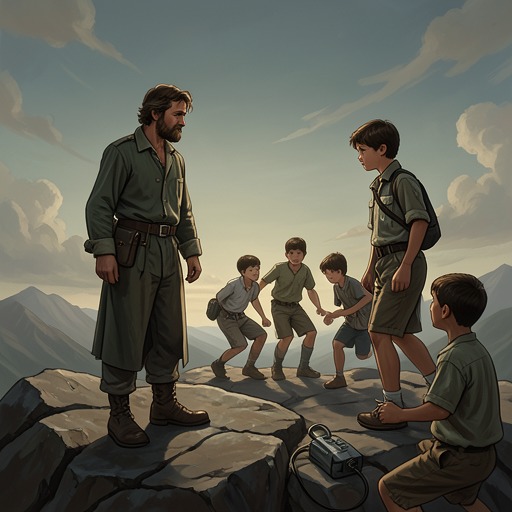
The first expedition gives the boys a brief sense of freedom almost without limit. Ralph, Jack Merridew, and Simon climb to a high point, survey the sea and reef, and celebrate their discovery of an apparently uninhabited island. They laugh, tumble, and shout as they descend. The view makes the place seem to belong to them, and exploration still feels like a shared adventure rather than a contest for power. Yet their early triumph already contains a blind spot: the group’s confident talk of possession and hunting does not include much attention to the costs of what they intend to do.
The first election similarly combines a real effort at order with the pleasures of performance. Jack Merridew claims the leadership on the basis of his position as head boy and chorister, while a call for a vote turns choosing a chief into an entertaining novelty. Ralph is elected, and he assigns the choir to Jack Merridew, who chooses to make them hunters. The process is not simply a secure democratic foundation: Jack Merridew is humiliated by the result, and Piggy’s intelligence and contribution to finding The conch do not earn him a place in the expedition. When Piggy objects to being excluded, Ralph sends him back to record names. The new order offers the boys a language of participation, but their first decisions already distribute dignity and belonging unevenly.
Play, Vulnerability, and the First Cruelties
The littluns’ beach play makes innocence visible as absorbed, small-scale attention. Henry, Percival, and Johnny build sand castles and decorate them with shells, flowers, and stones; their game forms a world whose significance exists at their own level. Maurice and Roger destroy the castles as they pass. Maurice feels an uneasy reminder of the punishment he would have received in his former life, and hurries away, while Roger stays to watch. His lingering presence and Johnny’s renewed torment of Percival show that the harm is not merely accidental damage: the vulnerable child is left crying, then made to cry again. The scene sets an early limit on any idea that the boys begin in unbroken harmony, while showing how the absence of adult correction weakens an old restraint without immediately erasing its memory.
Ralph’s growing awareness of his body marks a quieter change. During a pause on the pig-run, he longs for scissors, a proper bath, soap, and a toothbrush, and notices that his nails are bitten to the quick. His hair, clothes, and skin have become dirty through daily life on The island. More important than the dirt itself is his realization that he has begun to accept these conditions as normal. What once would have registered as a temporary deprivation is settling into habit; the altered appearance gives physical form to a changed standard of life.
Hunting Turns Play into Violence
The mock hunt of Robert makes the shift from play to harm stark. After Ralph wounds a boar, the boys replay the excitement of hunting by forming a ring around Robert. At first he makes mock rushes, but the circle closes, blows fall, and his cries that they are hurting him are followed by further attacks. Ralph joins in, seized by the excitement of reaching the exposed boy. The chant and pig-killing noises turn their violence into a shared performance, while Robert is left frightened and hurt. When the boys finally pause, they call it a game; Ralph is uneasy even as the others discuss how a drum, a fire, or a real pig might make the performance more convincing. The episode reveals how easily a pretend hunt can acquire real pain, and how the group’s exhilaration can overpower an individual’s distress.
This crossing of play and cruelty has consequences for the boys’ sense of what violence permits. The performance offers a temporary feeling of common purpose, but it also rehearses the hunters’ ability to surround a victim, excite one another, and treat pain as entertainment. The idea of a real victim is voiced openly, and the suggestion of using a littlun is met with laughter. The unease in Ralph’s response does not stop the game or restore the boundary it has crossed.
Masks, Factions, and the Loss of Restraint
As Jack Merridew breaks away from Ralph’s group, the boys’ identities become more visibly divided. Painted hunters raid the camp, seize burning branches, and invite the others to a feast; Jack Merridew presents his tribe as a place of hunting, meat, and fun. Face paint lets him address the group from behind a mask, while the invitation makes food and membership part of the same appeal. The split is not only a disagreement over leadership: it organizes belonging around a chief and hunting, against Ralph’s continuing insistence on maintaining The signal fire as a chance of rescue.
The encounter at Castle Rock shows how the group’s new loyalties become coercive. Ralph comes with Piggy and the twins, Sam and Eric, to demand Piggy’s glasses and argue that a visible rescue fire is necessary. Jack Merridew orders Sam and Eric to be seized and tied up; the painted group obeys, and he points to their obedience as proof of his authority. The twins’ protests meet a collective force they cannot resist. Roger then approaches them with an authority that seems to exceed even Jack Merridew’s commands. The scene replaces the early promise of shared rules with power enforced through group pressure and threat.
Piggy’s death and the disappearance of The conch mark a further collapse of the order that had once gathered the boys for assemblies. Jack Merridew claims the chief’s position and attacks Ralph as the tribe advances. The loss is not simply of childhood manners: the objects and procedures associated with discussion and rescue no longer protect those who depend on them. Across these episodes, innocence disappears by degrees, as remembered restraints, spontaneous play, and communal rules are successively subordinated to appetite, performance, and power.